|
It is not clear when Fakenham
had its first settlement, but the discovery of flint tools and weapons
suggest the area was inhabited during Neolithic time. There is also
evidence of a settlement in Roman times on Beacon Hill.
The Doomsday Book in 1086 AD states that Fakenham
had a population of 150, vastly different from today’s ever-increasing
population. The town’s oldest complete house is at the junction
of Tunn Street and Swan Street and dates from the 17th Century.
Nearby is Fakenham’s
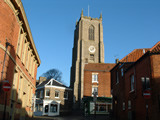
market place, which was granted in 1250. The church is close to
the market, which is a common feature of Norfolk’s market
towns, and its size, stature and tall tower denotes that Fakenham
was a wealthy settlement during medieval times.
Agriculture has been the principal industry of the town throughout
the centuries and the Doomsday Book records that the river powered
three mills. Wind power was used in the 18th and 19th Centuries,
followed by gas and electricity.
The gas works were built in 1845 and
Fakenham’s gas museum tells the story of how gas was once
responsible for lighting up the whole town.
In 1862 Thomas Miller built up a prosperous business in printing,
which went from a local operation to a substantial concern supplying
books to a variety of major London publishers.
Today Fakenham
still has its market and has a small selection of shops like the
traditional butchers, bakers and greengrocers.
Return to towns
section |